
★★★★★ Rated 4.8 out of 5 Based on 525+ Google reviews
Google
"*" indicates required fields
★★★★★ Rated 4.8 out of 5 Based on 525+ Google reviews
Most Daisy Hill homes are quoted $$150–$ $349
Daisy Hill sits approximately 25 kilometres south-east of Brisbane’s CBD in Logan City, occupying a gently elevated position between Springwood to the north, Shailer Park to the south-west, Slacks Creek to the west, and the Daisy Hill Conservation Park forming the suburb’s eastern and south-eastern boundary. It’s a suburb that developed predominantly through the 1980s and into the 1990s as part of Logan City’s south-eastern residential expansion — producing a housing stock that is now 25 to 40 years old and entering the weathering phase where brick mortar joints become progressively more porous and hospitable to biological growth penetration. The generous block sizes that characterise much of Daisy Hill’s residential development, combined with the suburb’s direct conservation park adjacency, create a lifestyle environment that is genuinely distinctive within Logan City’s residential corridor.
What makes Daisy Hill unique from an exterior surface maintenance perspective is the Daisy Hill Conservation Park itself. The park — home to one of South East Queensland’s most significant koala populations and a rich native eucalypt ecosystem — generates a continuous and substantial organic load on the exterior surfaces of properties along the park boundary. Eucalypt pollen, bark debris, seed capsules, and leaf matter from the park’s native vegetation settle onto roofing, gutters, eaves, and wall surfaces of adjacent residential properties year-round at a rate substantially higher than standard suburban properties experience from street trees and garden plantings. This native vegetation organic load, combined with Bulimba Creek corridor humidity from the west and Logan City’s flat to gently undulating terrain, creates one of the most biologically active exterior maintenance environments in the south-east Brisbane corridor.
At House Washing Experts, we service the Logan City south-eastern corridor regularly — Springwood, Shailer Park, Rochedale South, Underwood, Slacks Creek, Cornubia. Daisy Hill is familiar ground. We understand the conservation park-adjacent organic load conditions, the Bulimba Creek corridor humidity, and the 1980s and 1990s brick veneer housing stock that defines the suburb’s residential character.
Daisy Hill sits within our Logan City south-eastern service corridor — a zone we cover as part of our regular weekly schedule from our Rochedale base. No travel loading on your quote, fast booking availability, and a crew that arrives understanding what conservation park-adjacent and creek corridor-influenced brick veneer homes in Logan City’s south-east typically present in terms of organic load, surface conditions, and biological growth profile.
We quote every Daisy Hill property individually based on house size, surface type, contamination level, storey height, access, and proximity to the Daisy Hill Conservation Park or Bulimba Creek corridor. Properties on the park boundary require a different treatment intensity to standard estate positions further from the reserve — and we factor this into your written fixed-price quote before we start rather than adding it as a surcharge on the day.
Written fixed-price quote before we begin. Satisfaction guarantee when we finish. The right method for every surface on your property — every time.
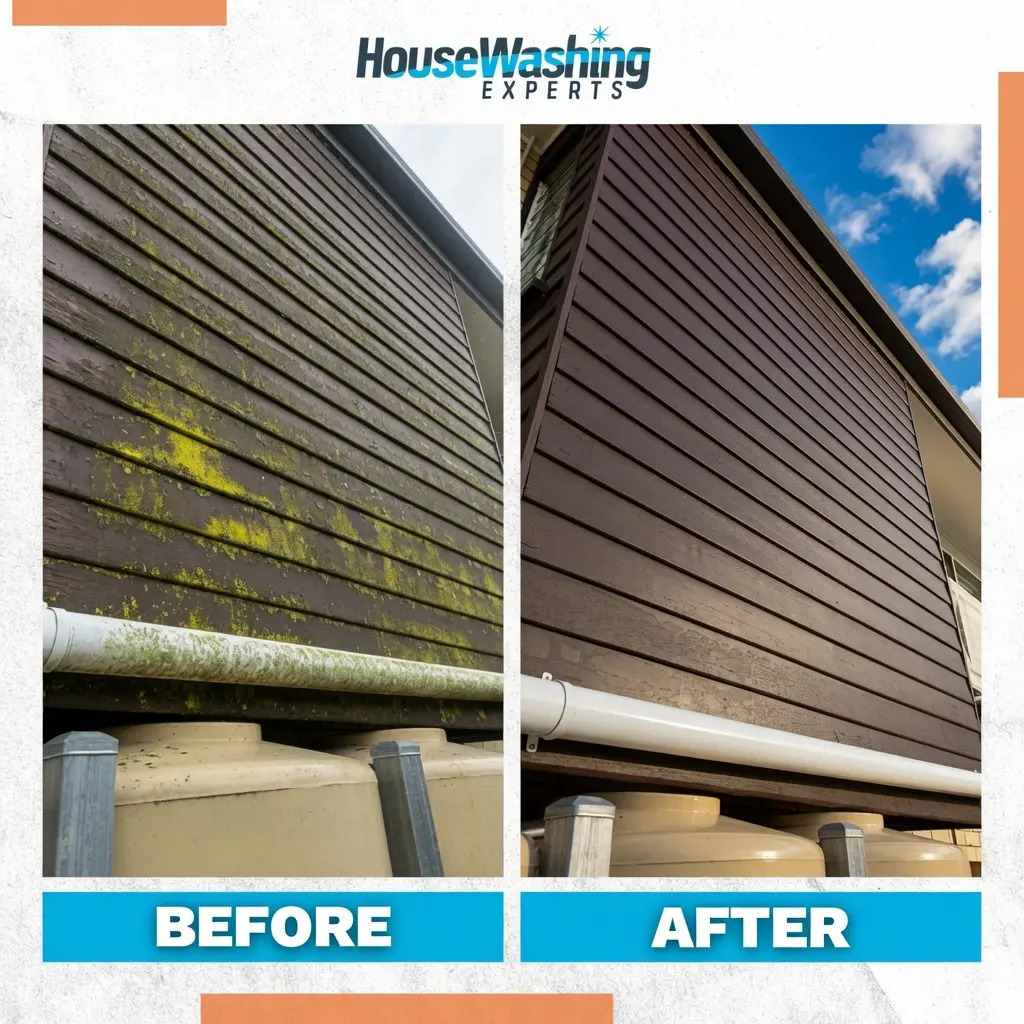
Green and black biological growth on brick veneer walls is the defining exterior maintenance problem across Daisy Hill’s 1980s and 1990s housing stock. Mould and algae colonise mortar joints first — the most porous element of the wall system — before spreading across the brick face on south and west-facing elevations where drying time after rain is slowest. On properties adjacent to the Daisy Hill Conservation Park, the combination of elevated organic load from native vegetation and the localised humidity created by the park’s dense native eucalypt ecosystem accelerates biological growth on park-facing elevations significantly above what standard estate properties experience. Our soft wash treatment with biodegradable biocide solution penetrates mortar joints and kills biological growth at the root — not just at the visible surface, which is all pressure washing alone achieves.
Daisy Hill’s residential roofing — predominantly concrete and terracotta tile across the suburb’s 1980s and 1990s estate housing stock — develops lichen and algae streaking that darkens progressively through each wet season. Properties adjacent to the conservation park develop heavier lichen coverage on south and east-facing roof pitches than equivalent estate properties away from the reserve — reflecting the elevated organic seeding from the park’s native eucalypt canopy above. On roofing now approaching 25 to 40 years old, lichen physically degrades tile glaze and mortar pointing over time. Our roof cleaning service removes all organic growth safely using the correct soft wash approach — without cracking, loosening, or dislodging tiles or damaging aged mortar pointing.
Daisy Hill properties adjacent to the conservation park and with established native garden plantings deal with a significantly higher tannin and organic staining load on driveways, paths, and paved areas than standard suburban properties. Native eucalypt leaf matter, bark strips, and seed capsules deposit tannin-rich organic material onto concrete surfaces continuously through the year — building into persistent brown-orange staining that standard pressure washing alone cannot fully lift on heavily affected park-adjacent properties. Our tannin pre-treatment solution applied before pressure washing addresses this staining at its source and restores a consistent surface across the full driveway and path area.
Properties adjacent to or near the Daisy Hill Conservation Park receive a substantially higher gutter organic load than standard suburban properties — native eucalypt bark strips, seed capsules, pollen, and leaf debris compact into gutter systems rapidly and hold moisture against fascia boards. On 25 to 40-year-old homes where original or early-replacement timber fascias may be present, moisture held against the fascia from blocked gutters accelerates deterioration significantly. Blocked gutters that overflow during Brisbane’s wet season also direct water against exterior walls, worsening the biological growth conditions on lower wall sections already affected by the park’s humidity environment. Our gutter cleaning service includes full interior debris removal, downpipe flushing, and outlet clearing — essential before each wet season for any Daisy Hill property adjacent to the conservation park.
Boundary fencing across Daisy Hill develops green algae staining on both faces wherever shade from established garden plantings, neighbouring structures, or the conservation park’s vegetation creates persistent slow-drying conditions after rain. Properties on the park boundary deal with fence lines that face directly onto native bushland — the most aggressive biological growth position for any fence surface in the suburb. We clean both faces of fencing where access allows and treat the surface to slow regrowth after cleaning.
Daisy Hill properties in lower-lying positions adjacent to the Bulimba Creek corridor or on blocks with flat terrain moisture retention develop efflorescence — white, chalky salt deposits on brick faces — at a rate reflecting active moisture movement through aged brickwork in an elevated ground moisture environment. Our brick cleaning service removes efflorescence safely alongside mould and organic staining without acid washing or mortar damage.
The Daisy Hill Conservation Park is one of South East Queensland’s most ecologically significant urban native reserves — home to a substantial koala population and a rich native eucalypt ecosystem that covers a substantial area on the suburb’s eastern and south-eastern boundary. The park’s native vegetation generates a continuous and substantial organic load on the exterior surfaces of adjacent residential properties — eucalypt pollen during flowering periods, bark debris year-round, seed capsules, and leaf matter that settles onto roofing, gutters, eaves, and wall surfaces at a rate that significantly exceeds what standard suburban properties receive from street trees and garden plantings. Properties on streets adjacent to the park boundary consistently present the heaviest tannin staining, fastest gutter debris accumulation, and most aggressive biological growth cycles in the suburb.
Bulimba Creek runs along and near Daisy Hill’s western boundary before flowing north through the inner-east corridor toward the Brisbane River. The creek generates localised humidity conditions that extend into the suburb’s western residential streets — keeping exterior surfaces on properties in proximity to the waterway damp for longer after rainfall events and morning dew than equivalent properties on higher, more open ground away from the creek. The combination of Bulimba Creek corridor humidity from the west and the conservation park’s native ecosystem moisture from the east creates a dual moisture influence that affects properties across Daisy Hill’s full residential width — though its intensity varies significantly by position within the suburb.
Daisy Hill’s established housing stock — built predominantly through the 1980s and into the 1990s — is now 25 to 40 years old and firmly in the weathering phase at which brick mortar joints become significantly more porous and hospitable to biological growth penetration. Mortar that was tight and impermeable when new has absorbed two to four decades of Queensland subtropical moisture and heat cycling, developing surface porosity that allows mould and algae to penetrate below the visible surface layer with each successive wet season. In combination with the conservation park organic load and Bulimba Creek humidity, this mortar porosity produces some of the most persistent biological growth conditions in Logan City’s south-eastern corridor.
Daisy Hill’s residential blocks — notably more generous than standard Logan City estate lots in many sections of the suburb — support established garden plantings that have had 25 to 40 years to develop into meaningful canopy. On south and west-facing wall elevations adjacent to established vegetation, boundary planting, and the conservation park’s native canopy on park-adjacent blocks, surface drying time after rainfall is significantly extended — creating the persistent moisture conditions where biological growth establishes fastest. Properties with established front garden plantings and those directly adjacent to the conservation park boundary consistently present the heaviest biological accumulation in the suburb.
Brisbane’s wet season — concentrated between November and March — delivers sustained high humidity and regular heavy rainfall that compounds all of Daisy Hill’s environmental moisture and organic load factors simultaneously. Bulimba Creek rises and extends its humidity influence into adjacent residential streets. The conservation park produces its highest seasonal organic debris volumes with summer eucalypt flowering and growth. And Brisbane’s subtropical warmth through the wet months creates the temperature and moisture conditions where untreated surfaces on Daisy Hill’s weathered brick veneer accumulate biological growth more aggressively than in standard Logan City suburban positions away from these natural corridors.
House Washing Experts provides a complete exterior cleaning service for all residential property types in Daisy Hill — established brick veneer estate homes from the 1980s and 1990s, newer infill and estate builds, and properties along the full range of the suburb’s positions from standard estate lots to conservation park-boundary and Bulimba Creek-adjacent sites. Our core service is a full exterior house wash using soft wash technique calibrated to your surface type, contamination level, and position within the suburb. We also offer roof cleaning for concrete and terracotta tile roofing, driveway and concrete path pressure washing with tannin pre-treatment where required, timber and Colorbond fence cleaning, internal gutter cleaning with full downpipe flushing and outlet clearing — particularly important for conservation park-adjacent properties given the native vegetation gutter load — window cleaning for all frame types, brick cleaning and efflorescence treatment, and solar panel cleaning with low-pressure de-ionised water technique. All services can be combined into a single visit for maximum efficiency and value.
We’re Local We’re based in Rochedale and service the Logan City south-eastern corridor regularly. Daisy Hill is familiar ground — we know the 1980s and 1990s brick veneer housing stock, the conservation park organic load conditions, the Bulimba Creek western corridor humidity, and how contamination profiles vary across the suburb’s different positions. You’re getting a team that treats these specific conditions regularly, not a generalist crew encountering them for the first time.
We’re Available When You Need Us We respond within 60 minutes during business hours and can typically have a crew at your Daisy Hill property within 24 hours of booking. For rental inspections, pre-sale preparation, or time-sensitive bookings, tell us your deadline and we’ll prioritise accordingly.
We Use the Right Method for Every Surface Soft wash for brick veneer, mortar joints, render, and tile roofing. Tannin pre-treatment and pressure washing for concrete driveways and hard paving. For conservation park-adjacent properties where organic load and biological contamination are heavier than standard estate positions, we adjust biocide concentration and dwell time to reflect the specific contamination environment your property sits in.
No Subcontractors — Ever When you book with House Washing Experts, our own trained team shows up. We do not subcontract to third parties. The crew that quotes your property is the crew that cleans it — the only way we can stand behind our 100% satisfaction guarantee.
Transparent Fixed-Price Quotes We quote after assessing your property, surface types, scope, and position within the suburb. The price we give you is the price on the invoice. No hidden call-out fees, no surprise add-ons after we arrive. What you’re quoted is what you pay.
Step 1 — Free Quote Contact us by phone or request a quote online. For Daisy Hill properties adjacent to the Daisy Hill Conservation Park or the Bulimba Creek corridor, include your approximate location and surface types at quote stage — this helps us correctly assess contamination intensity and biocide treatment requirements before arrival. No call-out fees, no obligation.
Step 2 — Booking Confirmation Accept the quote and we confirm your booking with a date that suits your schedule. Written confirmation and a day-before reminder. We respond within 60 minutes during business hours and keep to our schedule.
Step 3 — Surface and Position Assessment on Arrival We walk the full exterior on arrival to confirm scope, assess surface conditions, and identify the specific contamination profile based on your property’s position within the suburb. Conservation park-adjacent and Bulimba Creek-adjacent properties require higher biocide concentration and longer dwell time than standard estate positions. Any changes from the quote are discussed before work begins.
Step 4 — Soft Wash Application We apply our low-pressure soft wash treatment to all exterior wall surfaces, eaves, fascias, and areas of biological growth. On Daisy Hill’s weathered 1980s and 1990s brick veneer and mortar, correct dwell time is observed to ensure biological growth is killed at the root level in mortar joints and on brick faces — not merely dislodged at the visible surface for faster regrowth.
Step 5 — Roof, Driveway, Gutters, and Site Completion Roof cleaning, driveway and path pressure washing, fence cleaning, and gutter cleaning are completed where included in the booking scope. For conservation park-adjacent properties, gutter cleaning is particularly important given the volume of native vegetation debris that compacts into gutter systems between services. We conduct a thorough walkthrough of the full exterior to confirm every surface meets our standard before packing down.
Step 6 — Post-Clean Treatment and Sign-Off A mould inhibitor is applied after washing to slow biological regrowth and extend the interval between cleans — particularly important for conservation park-adjacent and creek-adjacent Daisy Hill properties where the organic and moisture environment produces faster regrowth cycles than standard estate positions. We provide before and after photos on request and flag any surface damage, efflorescence, gutter issues, or maintenance concerns observed during the clean.
We service all residential streets across Daisy Hill including properties along Springwood Road, Miles Platting Road, Daisy Hill Road, and the residential estate grid running between the Bulimba Creek western corridor and the Daisy Hill Conservation Park eastern and south-eastern boundary. We regularly clean homes on the streets directly adjacent to the conservation park boundary, properties in the established 1980s estate sections in the suburb’s northern pockets, and the residential streetscapes running toward Springwood to the north and Shailer Park to the south-west. We’re familiar with Daisy Hill’s block configurations — including properties on the conservation park boundary with direct reserve frontage, standard estate lots in the suburb’s established residential grid, and homes on the western streets closest to the Bulimba Creek corridor.
Daisy Hill sits approximately 25 kilometres south-east of Brisbane’s CBD within Logan City, bordered by Springwood to the north, Shailer Park to the south-west, Slacks Creek to the west, and the Daisy Hill Conservation Park to the east and south-east. Springwood Road and Miles Platting Road form the primary arterial connectors through and around the suburb, with Daisy Hill Road providing the key internal route. Our crews service Daisy Hill from our Rochedale base as part of our regular Logan City south-eastern corridor schedule — no travel surcharge, response within 60 minutes during business hours, and booking availability typically within 24 hours. Call us to confirm availability for your specific address and position within the suburb.
Most Daisy Hill homes are quoted between $150 and $349 for a full exterior wash, depending on house size, surface type, and contamination level. Properties adjacent to the Daisy Hill Conservation Park with elevated biological growth and organic load from the park’s native vegetation, or those near the Bulimba Creek corridor with elevated humidity conditions, may be quoted toward the higher end of this range to reflect the treatment intensity required. All quotes are fixed-price — no hidden charges, no day-of adjustments.
Yes — significantly. Properties adjacent to the Daisy Hill Conservation Park experience the highest native vegetation organic load in the suburb — eucalypt pollen, bark debris, seed capsules, and leaf matter from the park’s native ecosystem settle onto roofing, gutters, eaves, and wall surfaces year-round at a rate substantially higher than standard suburban properties receive from street trees alone. This elevated organic load accelerates biological growth cycles and gutter debris accumulation on park-adjacent properties above what standard estate positions experience. We factor this into the biocide concentration, dwell time, and treatment approach for every park-adjacent job in Daisy Hill.
Yes — soft washing is specifically the correct method for brick veneer surfaces. Low-pressure biocide treatment penetrates mortar joints and kills biological growth at the root without damaging the mortar or brick face. High-pressure washing on brick veneer disturbs surface growth without killing it at the root, produces faster regrowth, and can damage weathered mortar on 25 to 40-year-old homes. We use soft washing on all brick veneer surfaces in Daisy Hill by default.
It’s essential — and we recommend scheduling it before each wet season for any conservation park-adjacent property. The volume of native eucalypt bark strips, seed capsules, and leaf debris that the park’s vegetation deposits into adjacent gutters is substantially higher than standard suburban gutter organic load. This material compacts rapidly into gutter systems, holds moisture against fascia boards, and overflows during wet season events to direct water against exterior walls. Annual or twice-yearly gutter cleaning for park-adjacent properties is the most cost-effective way to prevent the moisture damage and accelerated biological growth that blocked gutters cause in these positions.
Most Daisy Hill properties benefit from a full exterior wash every 12 to 18 months. Properties adjacent to the Daisy Hill Conservation Park or the Bulimba Creek corridor, or those with significant south-facing brick elevations under established canopy, benefit from annual cleaning given the elevated organic load and moisture conditions in these positions. Our post-clean mould inhibitor treatment extends the interval between services significantly for all property types.
Yes. Our service area covers all surrounding Logan City south-eastern suburbs including Springwood, Shailer Park, Rochedale South, Underwood, Slacks Creek, Cornubia, Tanah Merah, and Carbrook. If you have a neighbouring property or nearby rental that also needs cleaning, we’re happy to quote both in the same visit.
Daisy Hill’s natural setting — the Daisy Hill Conservation Park on the eastern boundary and the Bulimba Creek corridor to the west — makes it one of Logan City’s most distinctively appealing residential suburbs. That same natural setting also makes it one of the most demanding exterior surface maintenance environments in the south-east Brisbane corridor. The conservation park’s native vegetation organic load, Bulimba Creek corridor humidity, and Brisbane’s subtropical wet season ensure biological growth returns annually to every untreated exterior surface in the suburb — and on park-adjacent properties, it returns faster and more aggressively than almost anywhere else in Logan City. Whether you’re an owner-occupier managing annual maintenance, a landlord protecting a rental property’s presentation, or a homeowner preparing to go to market in one of Logan City’s most sought-after natural settings — we can have a quote to you today and a crew at your property within 24 hours.
We’ll beat any genuine written quote by 10%
Get your free, no-obligation quote today and see why Brisbane homeowners trust House Washing Experts to keep their homes looking their best and protected all year round.